
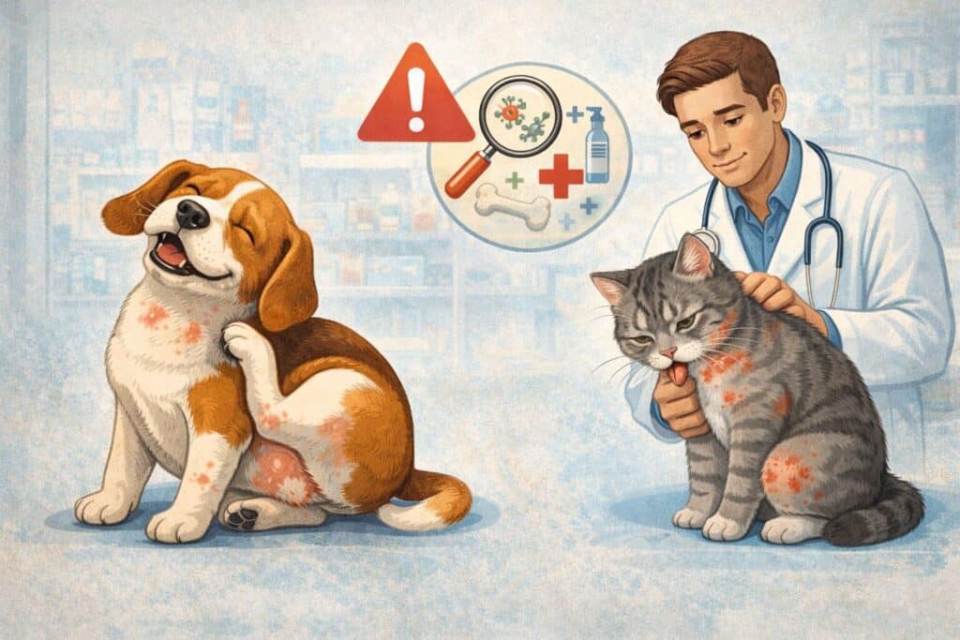
Itching, skin redness, and rash in pets should never be treated as a minor cosmetic issue only. In some dogs and cats, mild irritation may appear for a short time because of a temporary trigger such as contact irritation, seasonal factors, or a brief skin reaction. But if a pet keeps scratching, licking, chewing paws, rubbing the face, shaking the head, or develops red skin, bumps, scabs, patches of hair loss, or an unpleasant skin odor, it is already time to think about a proper veterinary dermatology consultation. These symptoms often point not to one simple problem, but to a whole group of possible causes, including allergy, parasites, bacterial or fungal infection, chronic skin inflammation, or ear disease.
Many owners first try to solve the issue on their own. They switch shampoos, use random skin products, try antihistamines, change food without a plan, or simply wait to see whether the skin improves by itself. This is one of the most common mistakes in pet dermatology. Skin problems often look similar on the surface but come from very different causes. A dog or cat with constant itching may have flea allergy dermatitis, food-related allergy, environmental allergy, skin infection, mites, ear inflammation, or a chronic allergic skin disease. If the treatment is chosen by guesswork, the result is often temporary or ineffective, while the real cause continues to worsen.
It is also important to understand that the skin rarely becomes inflamed “on its own” without an underlying reason. In many pets, the visible skin problem is only the outer sign of a deeper issue. If a pet is scratching all the time, it usually means the skin barrier is damaged, inflammation is active, and secondary complications may already be developing. Over time, constant self-trauma can lead to wounds, bacterial overgrowth, yeast infection, chronic thickening of the skin, dark discoloration, ear disease, and a much more difficult treatment process.
In this article, we explain why dogs and cats develop itching, skin redness, and rash, when these symptoms require a veterinary dermatologist, which warning signs should not be ignored, what owners should not do at home, and what diagnostics may be needed. The main idea is simple: with skin disease, the goal is not only to make the redness disappear, but to identify what is driving the inflammation in the first place.
Why Dogs and Cats Develop Itching, Red Skin, and Rash
There are many possible causes of skin symptoms in pets, and this is exactly why dermatology cases should not be treated casually. One of the most common reasons is allergy. In dogs and cats, skin inflammation may develop because of flea bites, food-related triggers, environmental allergens such as dust or pollen, or a broader allergic skin disease. In those cases, the pet often does not scratch occasionally. Instead, scratching becomes frequent, repetitive, and focused on certain areas such as the ears, face, paws, belly, groin, tail base, or sides of the body. Over time, the skin becomes red, irritated, and damaged from constant licking, chewing, and scratching.
Another major category is parasitic skin disease. Even if an owner does not see fleas or other parasites, that does not mean parasites are not involved. Some pets react so strongly to flea bites that even minimal exposure can trigger severe itching and inflammation. In addition to fleas, mites and other parasites may cause redness, scaling, crusting, hair loss, and strong discomfort. Without proper skin examination, these conditions are easy to confuse with allergy or infection. That is one reason why dermatologic evaluation often needs more than visual inspection alone.
Bacterial and yeast infections are also extremely common in itchy pets. Sometimes they are the primary issue, but very often they develop secondarily on top of allergic or damaged skin. When that happens, owners may notice a stronger smell, greasy fur, red irritated folds, pustules, crusts, moist skin lesions, or darkened thickened areas. These secondary infections are important because even if the original trigger is allergy, the infection itself can make the pet itch much more severely. A dog with an allergic background may look dramatically worse once infection is added to the picture.
Ear problems are another very important part of the same dermatologic pattern. A dog or cat that constantly shakes the head, scratches around the ears, develops discharge, redness, or odor may not have a separate unrelated ear problem. Very often, the ears are part of the same underlying allergic or inflammatory disease affecting the skin. Owners sometimes focus only on the ear signs and miss the fact that the paws, belly, armpits, groin, or face are also involved.
Skin symptoms can also be linked to contact irritation, grooming-related issues, chronic skin barrier damage, hormonal factors, or improper home care. Overbathing, harsh shampoos, inappropriate topical products, or “human” creams can worsen inflammation rather than help it. That is why home treatment based on general assumptions often delays the correct diagnosis instead of improving the condition.
The key point is that itching, redness, and rash are not a diagnosis by themselves. They are outward signs of inflammation. To treat the pet properly, the real cause has to be identified rather than guessed.
When Itching and Rash Mean a Veterinary Dermatologist Is Needed
Not every short episode of scratching means a serious skin disease, but there are clear situations where waiting is the wrong choice. If a pet scratches once in a while and the skin still looks normal, with no redness, no odor, no rash, no hair loss, and no repetitive licking or chewing, short observation may sometimes be reasonable. But once the scratching becomes regular, intense, or linked to visible skin changes, the situation is no longer something to postpone for long.
One of the clearest signs that a veterinary dermatologist is needed is constant or recurrent itching. If a dog or cat repeatedly licks paws, scratches the neck, rubs the face, chews the skin, shakes the head, or seems unable to settle because of skin discomfort, this is not normal grooming behavior anymore. Recurrent itching strongly suggests that the skin is affected by an ongoing inflammatory process. That process may be allergic, infectious, parasitic, or mixed, but in all cases it deserves proper medical evaluation.
Visible skin and coat changes are another strong reason to seek help. Red skin, bumps, scabs, patchy hair loss, greasy coat, scaling, thickened skin, darkened skin, unpleasant smell, or moist inflamed areas all indicate that the problem is established and not purely superficial. At that point, it is not enough to “try another shampoo” or wait for the skin to calm down on its own. The longer active inflammation continues, the more likely it is that secondary infection or chronic skin damage will develop.
Recurring ear problems are also highly relevant. If the pet frequently shakes the head, scratches the ears, or develops discharge, irritation, or odor in the ear canals, that may be part of the same dermatologic disease. Repeated ear treatment without evaluating the whole skin picture often gives only temporary relief, while the underlying condition remains active.
Another strong reason not to wait is when the itching is clearly affecting the pet’s quality of life. If the animal cannot rest normally, interrupts sleep to scratch, becomes irritable, avoids touch, or spends a large part of the day licking and chewing the body, the discomfort is already significant. In more severe cases, the pet may scratch hard enough to create wounds and increase the risk of secondary infection.
Owners should also take skin symptoms especially seriously when they are associated with more general signs such as lethargy, poor appetite, or broader health changes. In such cases, the skin may not be the only system involved. A broader workup including laboratory tests may be needed in addition to dermatologic examination.
Skin Symptoms That Should Never Be Ignored
The most dangerous assumption is that itching and redness are always minor. In reality, chronic skin inflammation tends to get worse over time if the cause is not identified. Some skin changes may look simple at first but can progress into more complicated and painful disease.
You should arrange veterinary assessment promptly if your pet has:
- constant or severe itching that does not stop;
- red skin, especially if it is spreading or worsening;
- rash, crusts, pustules, or moist skin lesions;
- hair loss or patchy bald areas;
- persistent paw licking or chewing;
- recurrent ear problems such as scratching, discharge, or odor;
- bad smell from the skin or ears;
- self-trauma such as wounds from scratching or chewing;
- skin thickening or dark discoloration in chronically inflamed areas;
- skin symptoms together with lethargy, appetite loss, or other systemic signs.
When these signs are present, it is much better to arrange an examination and consultation than to keep trying random home products. Persistent skin symptoms usually mean that the underlying process is active and needs a clear diagnosis.
What Owners Can Do at Home and What They Should Avoid
The most useful thing an owner can do at home is to avoid making the skin problem worse and to collect good information for the veterinarian. You should pay attention to which body areas are affected most, whether the itching is seasonal or constant, whether the ears are involved, whether the pet licks paws, whether there is odor, whether the coat is changing, and whether food, shampoo, environment, or parasite prevention has changed recently. This information can be extremely valuable during the consultation.
What owners should not do is start aggressive and random treatment. Frequent bathing, harsh shampoos, alcohol-based products, iodine, hydrogen peroxide, strong antiseptics, human steroid creams, and “whatever helped another pet” can all make the situation worse. These products may damage the already weakened skin barrier, irritate inflamed tissue, and make it harder for the veterinarian to interpret the real condition of the skin during the visit.
It is also a mistake to begin guess-based treatment with antihistamines, antibiotics, antifungal drugs, steroid creams, or ear products without a diagnosis. Skin diseases often overlap. A temporary reduction in redness or scratching does not mean the real cause has been treated. In fact, partially suppressing symptoms without addressing the cause may prolong the disease and complicate later diagnostics.
Owners should also review parasite prevention. If flea and parasite control is irregular, incomplete, or uncertain, this is important information for the veterinarian. But it is also important not to assume that skin parasites are impossible simply because none were seen. Dermatology cases often require more precise assessment than home observation alone can provide.
If the pet is scratching intensely, it may be helpful to minimize self-trauma as much as possible until the visit, but without improvising risky treatments. The goal is to reduce harm, not to replace diagnosis. This may simply mean preventing excessive friction, avoiding irritants, and not letting the pet worsen the skin with additional home products.
In short, the best home approach is not blind treatment. It is structured observation, gentle handling, and timely veterinary evaluation. Dermatologic disease is rarely solved well by random experimentation.
What Diagnostics May Be Needed for Itching and Rash
In veterinary dermatology, the goal is not only to confirm that the skin is inflamed, but to understand why. That is why the diagnostic process usually starts with a detailed history and clinical examination. The veterinarian will ask when the symptoms began, whether they are seasonal, which parts of the body are most affected, whether ear problems are present, what food the pet receives, whether parasite prevention is used regularly, and whether there were previous similar episodes. This history is extremely important because skin disease often follows patterns over time.
During the examination, the veterinarian evaluates the skin, coat, paws, ears, and general condition. In many cases, dermatologic testing is needed during the visit rather than relying only on appearance. Depending on the findings, this may include skin scrapings, cytology, coat and skin assessment, ear evaluation, or other targeted tests. These steps help distinguish allergy from parasite infestation, secondary bacterial infection, yeast overgrowth, and other common causes of itching and rash.
If the skin problem may be part of a broader health issue, laboratory diagnostics may also be important. Blood tests can help assess whether there are systemic inflammatory changes, metabolic problems, or other internal issues that may influence the skin. This is especially relevant in chronic or recurrent cases, in pets with more general health changes, or when the skin problem seems more complex than a straightforward localized dermatitis.
When allergy is suspected, the process often involves rule-out logic rather than one simple “allergy test.” The veterinarian may need to consider flea allergy, food-related triggers, environmental allergy, secondary infections, chronic skin barrier damage, and ear disease as part of the same picture. In that context, pages related to allergy-related conditions in pets and dermatology become clinically relevant because they reflect the type of structured, cause-based approach needed in these patients.
Chronic cases often require a broader plan, because treatment must address not only the itching but also secondary infection, inflammation, skin barrier damage, and the primary trigger. This is why professional dermatology care is so valuable. A dog or cat with chronic skin disease often needs a step-by-step strategy rather than a single product.
The most important point is that skin symptoms can look simple while the real cause is not simple at all. Proper dermatologic workup increases the chance of stable control and reduces the risk of repeated flare-ups.
Conclusion: When Waiting Becomes the Wrong Strategy
Itching, skin redness, and rash in pets are important warning signs that the skin is inflamed for a reason. In some cases, the cause may be relatively straightforward, but without examination it is often impossible to reliably separate allergy from parasites, infection, ear disease, or chronic inflammatory skin conditions. That is why repeated or worsening skin symptoms should not be treated as a small issue that can safely be ignored for weeks.
If your dog or cat is constantly scratching, licking paws, developing red skin, rash, hair loss, crusts, odor, or repeated ear irritation, the right decision is usually to seek help early. The longer the skin remains inflamed, the greater the chance of secondary infection, chronic thickening, pigmentation changes, and much more difficult treatment later.
One of the most common mistakes owners make is trying to treat skin disease by appearance alone. But the same outward signs can come from very different causes, which means the treatment must also be different. Real progress in dermatology usually comes from a structured medical approach: examination, diagnostic testing where needed, identification of the trigger, treatment of secondary complications, and a plan for long-term control if the condition is chronic.
If your pet has itching, skin redness, or rash, it is wise to arrange an appointment and, if needed, a proper veterinary dermatology evaluation. Timely consultation helps reduce discomfort, prevent complications, and identify the true cause instead of only suppressing visible symptoms for a short time.
