
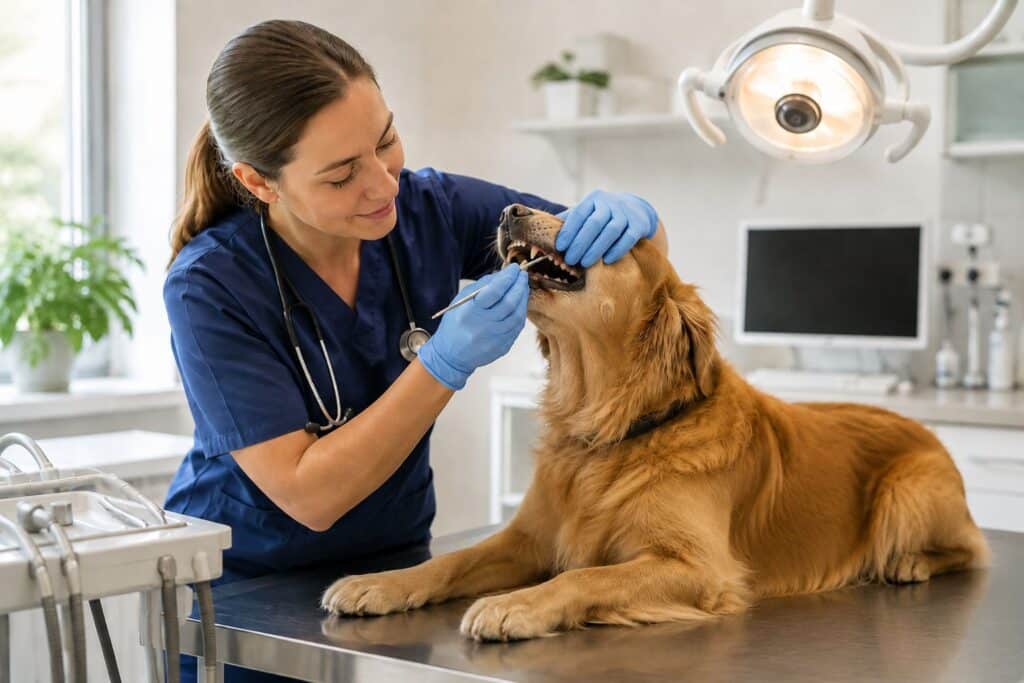
A dog or cat needs professional teeth cleaning when tartar, plaque, or bad breath appears. At HAB VET (Kyiv), ultrasonic cleaning costs from 6500 ₴ including the anesthesiology block, a dental consultation is 950 ₴, and tooth extraction starts from 300 ₴ depending on the type. The final sum is set after examination. The clinic works 9:00–20:00.
Dental health directly affects the wellbeing of a dog or cat. Tartar, plaque, and gum inflammation cause bad breath and can also lead to pain and tooth loss. Below you’ll find answers to the key questions owners ask: when a pet needs professional cleaning, what the ultrasonic procedure is, how everything works, when a tooth has to be extracted, how much it costs, and how to care for teeth at home.
When Does a Dog or Cat Need Professional Teeth Cleaning?
A dog or cat needs professional teeth cleaning when persistent plaque and tartar form on the teeth and can’t be removed by home care. The main signals for owners are bad breath, yellow or brown deposits near the base of the teeth, red or bleeding gums, and cautious behavior while eating. Noticing these signs, it’s worth seeing a vet for an examination.
Regular monitoring of the oral cavity helps detect the problem early, when cleaning alone is enough without more complex interventions. Neglected tartar over time provokes gum inflammation, loosening, and tooth loss, so the visit shouldn’t be postponed.
Signs of tartar and dental problems
Typical signs include persistent bad breath, visible plaque and tartar on the teeth, swollen or reddened gums, increased salivation, and changes in eating behavior when the animal chews cautiously or avoids hard food. Any of these symptoms is a reason to show the animal to a vet.
How often professional cleaning is needed
The frequency of professional cleaning is determined by the vet individually after examination, since it depends on the breed, age, diet, and the particular animal’s tendency to form deposits. Regular scheduled check-ups help set the optimal schedule and prevent serious problems.
What Is Ultrasonic Teeth Cleaning for Dogs and Cats?
Ultrasonic teeth cleaning is a procedure for removing tartar and plaque using ultrasonic vibrations. A special tip generates high-frequency vibrations that break down and detach deposits from the tooth surface, including the area near the gums that’s hard to reach with regular home care. The procedure is performed by a specialist in clinic conditions.
Ultrasonic cleaning differs from mechanical tartar removal primarily in its principle of action: the mechanical method removes deposits with hand instruments, while ultrasound works through vibration. Both aim to clear the teeth of tartar and plaque, and the specific method is chosen depending on the state of the animal’s oral cavity. Since the procedure requires thorough treatment below the gums, it’s carried out under the supervision of an anesthesiologist. You can learn more in the veterinary dentistry section.
Is Anesthesia Needed for Professional Teeth Cleaning?
Dental manipulations at HAB VET are carried out under the supervision of an anesthesiologist, and complex interventions are performed with the use of anesthesia. This allows the procedure to be done effectively and safely, especially when thorough treatment below the gums is needed. The specific anesthesia plan is determined after assessing the animal’s condition, taking into account the amount of deposits, the state of the oral cavity, behavior, and general health.
The goal is for the procedure to be as comfortable and effective as possible, so the specialist can thoroughly perform all necessary manipulations. If you have doubts or questions about anesthesiology support, it’s best to discuss them directly at the consultation, where the vet will explain which option suits your animal and why.
How Does the Teeth Cleaning Procedure Work?
The professional teeth cleaning procedure includes an oral examination, preparation, the removal of tartar and plaque, and subsequent monitoring of the animal. First, the vet assesses the condition of the teeth and gums, determines the scope of work, and, if needed, prescribes additional tests. This allows the procedure to be performed safely and takes the animal’s individual features into account.
Proper preparation before cleaning and attentive monitoring afterward are equally important for a good result. Let’s look at the two key stages in more detail.
Preparation and pre-op examination
Before cleaning, an examination is carried out to assess the state of the oral cavity and the animal’s general health. If needed, the vet prescribes additional tests, especially if an intervention requiring anesthesia is planned. Exact preparation recommendations, including fasting, are provided by the vet individually at booking.
What happens during the cleaning
During the procedure, the specialist removes tartar and plaque from the tooth surface, including the area near the gums. After cleaning, the vet inspects each tooth, assesses the state of the oral cavity, and decides on further steps if problematic teeth are found. At the end, the animal remains under staff supervision until full recovery.
When Is Tooth Extraction Needed for Dogs and Cats?
Tooth extraction in a dog or cat is needed when the tooth can no longer be saved and treated. This applies to heavily destroyed teeth, significant loosening due to inflammation or gum recession, deep damage, and cases where a diseased tooth becomes a source of pain and infection. Extraction in such situations removes the focus of inflammation and eases the animal’s condition.
Tooth extraction is performed under general anesthesia, which allows the manipulation to be done painlessly. The scope varies: from removing a baby or single-root tooth to the more complex extraction of multi-root teeth or the root of a broken tooth. The decision is always made by the vet after assessing each tooth. When possible, the specialist tries to save the tooth, so extraction is a necessary step only when other options are no longer appropriate. It’s important not to postpone the visit at the first signs of a problem: the earlier the damage is detected, the greater the chance of avoiding extraction.
How Much Do Teeth Cleaning and Extraction Cost in Kyiv?
At HAB VET, dental services have specific prices. A dental consultation costs 950 ₴, a follow-up examination — 750 ₴. Ultrasonic teeth cleaning is from 6500 ₴, including the anesthesiology block. The cost of extraction depends on the tooth type: a baby tooth (except a canine) — 300 ₴, a baby canine — 400 ₴, a permanent single-root tooth — 300 ₴, a two-root — 700 ₴, a three-root — 800 ₴, a permanent canine — 800 ₴, and the root of a broken tooth — 600 ₴.
These prices help you orient in advance, but the final sum depends on the scope of the needed procedures and is set after examination. For example, a simple cleaning and a case additionally requiring the extraction of several complex teeth differ significantly in complexity. To find out the cost for your animal, it’s convenient to book a teeth cleaning right away — during the appointment you’ll receive an individual estimate based on the current price list.
Caring for Your Pet’s Teeth After the Procedure
Caring for teeth after the procedure comes down to following the vet’s recommendations, ensuring rest in the first days, and preventing tartar afterward. Right after cleaning or extraction, the animal needs a gentle regimen: a calm environment, access to water, and feeding according to the specialist’s advice. Attentive monitoring in the first days helps notice any deviations in time.
In the longer term, the main task is to prevent tartar from re-forming quickly. This requires regular home care and scheduled check-ups, during which the vet monitors the state of the oral cavity and adjusts recommendations if needed.
The first days after the procedure
In the first days, ensure the animal has rest and follow the vet’s feeding recommendations. If a tooth was extracted, a temporary switch to softer food may be needed. If warning symptoms appear, such as refusal to eat, swelling, or lethargy, you should contact the clinic.
Tartar prevention at home
Regular home care helps slow the formation of new plaque and tartar between professional cleanings. The specific products and care frequency are worth agreeing on with the vet, and it’s important not to skip scheduled check-ups, which help maintain the animal’s dental health.
Frequently Asked Questions
Can I clean my dog’s or cat’s teeth at home?
Yes, home dental care is beneficial and helps slow plaque formation between professional cleanings. For this, special products for animals are used, getting the dog or cat used to the procedure gradually. However, home cleaning doesn’t replace professional cleaning, since it can’t remove already-formed tartar, especially below the gum line. The optimal products and care frequency are worth agreeing on with the vet at an appointment.
What does bad breath in a dog or cat mean?
Persistent bad breath most often indicates a buildup of tartar, plaque, or gum inflammation, and sometimes problematic teeth needing attention. It’s a common signal that it’s time for an oral examination. Occasionally the odor may be linked to other conditions in the body, so determining the exact cause and choosing a solution is best done by the vet after examining the animal.
Do I need to prepare my pet for a dental procedure?
Yes, preparation may be needed, especially if an intervention requiring anesthesia is planned. Usually, before the procedure the vet examines the animal, prescribes additional tests if needed, and gives fasting recommendations. Exact requirements depend on the specific case, the animal’s age, and its health, so they’re worth clarifying directly at booking or consultation rather than relying on general advice from the internet.
How do I care for my pet after a tooth extraction?
After an extraction, the animal needs a gentle regimen: rest, access to water, and feeding per the vet’s recommendations, sometimes with a temporary switch to softer food. It’s important to monitor the animal’s condition closely in the first days and follow all prescriptions. If warning symptoms appear, such as prolonged refusal to eat, swelling, bleeding, or marked lethargy, you should contact the clinic immediately for a follow-up examination.
How can I prevent tartar from re-forming?
To slow the re-formation of tartar, it’s important to combine regular home dental care with scheduled vet check-ups. Home cleaning with special products helps control plaque, while periodic clinic visits allow deposits to be detected in time and professional cleaning to be done when needed. The specific prevention plan, including products and frequency, is best chosen individually with the vet, taking your animal’s features into account.
Book a Dental Procedure at HAB VET
Noticed bad breath, plaque, or tartar in your dog or cat? At HAB VET in Kyiv, the vets will examine your animal’s oral cavity, give individual recommendations, and calculate the cost for your specific case. The clinic is open daily from 9:00 to 20:00. You can review the details and choose a convenient time on the dentistry for dogs and cats at HAB VET page — book your appointment today.
